Filter by
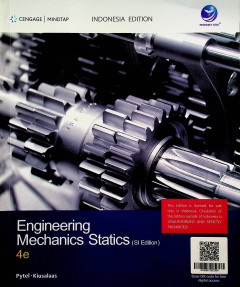
Engineering Mechanics Statics (SI Edition) 4e
- Edition
- 4th
- ISBN/ISSN
- 978-979-29-9833-7
- Collation
- xii, 587 p. : ill. ; 25 cm
- Series Title
- -
- Call Number
- 620.1 Pyt e
- Edition
- 4th
- ISBN/ISSN
- 978-979-29-9833-7
- Collation
- xii, 587 p. : ill. ; 25 cm
- Series Title
- -
- Call Number
- 620.1 Pyt e

Statics and Influence Functions
This extended and revised second edition is intended for engineering students and researchers working with finite element methods in structural and mechanical analysis. Discussing numerical structural analysis from first mechanical and mathematical principles, it establishes the central role of influence functions (Green's functions) in finite element analysis, reanalysis, sensitivity analysis,…
- Edition
- -
- ISBN/ISSN
- 978-3-030-55889-5
- Collation
- XV, 464p.:Ill
- Series Title
- Springer Series in Solid and Structural Mechanics
- Call Number
- 624.171 Har s

Dynamic Substructures, Volume 4
- Edition
- 1
- ISBN/ISSN
- 978-3-030-12184-6
- Collation
- VIII, 186p.:Ill
- Series Title
- Conference Proceedings of the Society for Experimental Mechanics Series
- Call Number
- 620.103 Dyn
- Edition
- 1
- ISBN/ISSN
- 978-3-030-12184-6
- Collation
- VIII, 186p.:Ill
- Series Title
- Conference Proceedings of the Society for Experimental Mechanics Series
- Call Number
- 620.103 Dyn

Structures: A Geometric Approach
Graphic methods for structural design essentially translate problems of algebra into geometric representations, allowing solutions to be reached using geometric construction (ie: drawing pictures) instead of tedious and error-prone arithmetic. This was the common method before the invention of calculators and computers, but had been largely abandoned in the last half century in favor of numeric…
- Edition
- 1
- ISBN/ISSN
- 978-3-319-98746-0
- Collation
- XI, 332p.:Ill
- Series Title
- -
- Call Number
- 624.171 2 Sal s

Computational Structural Analysis and Finite Element Methods
Graph theory gained initial prominence in science and engineering through its strong links with matrix algebra and computer science. Moreover, the structure of the mathematics is well suited to that of engineering problems in analysis and design. The methods of analysis in this book employ matrix algebra, graph theory and meta-heuristic algorithms, which are ideally suited for modern computatio…
- Edition
- 1
- ISBN/ISSN
- 978-3-319-02964-1
- Collation
- xvi,432p.: III.
- Series Title
- -
- Call Number
- 620.1 Kav c

Applied Statics and Strength of Materials, Fourth Edition
- Edition
- 4th
- ISBN/ISSN
- 0-13-093826-2
- Collation
- vi, 646 p. : ill. ; 29 cm
- Series Title
- -
- Call Number
- 620.1 Spi a
- Edition
- 4th
- ISBN/ISSN
- 0-13-093826-2
- Collation
- vi, 646 p. : ill. ; 29 cm
- Series Title
- -
- Call Number
- 620.1 Spi a

SCHAUM`S outlines: STATICS AND MECHANICS OF MATERIALS
- Edition
- -
- ISBN/ISSN
- 0-07-045896-0
- Collation
- vi, 282 p. : ill. ; 26 cm.
- Series Title
- -
- Call Number
- 620.1 Nas s
- Edition
- -
- ISBN/ISSN
- 0-07-045896-0
- Collation
- vi, 282 p. : ill. ; 26 cm.
- Series Title
- -
- Call Number
- 620.1 Nas s

STATICS, SECOND EDITION
- Edition
- 2nd
- ISBN/ISSN
- 0-314-04765-4
- Collation
- xi, 379 p. : ill. ; 24 cm.
- Series Title
- -
- Call Number
- 620.1 Gin s
- Edition
- 2nd
- ISBN/ISSN
- 0-314-04765-4
- Collation
- xi, 379 p. : ill. ; 24 cm.
- Series Title
- -
- Call Number
- 620.1 Gin s

Elementary Statics and Strength of Materials
- Edition
- 1
- ISBN/ISSN
- 0-07-010339-9
- Collation
- xv, 317 p. : ill, ; 24 cm
- Series Title
- -
- Call Number
- 624.171 Cer e 1981
- Edition
- 1
- ISBN/ISSN
- 0-07-010339-9
- Collation
- xv, 317 p. : ill, ; 24 cm
- Series Title
- -
- Call Number
- 624.171 Cer e 1981

STATICS AND STRENGTH OF MATERIALS
- Edition
- 0
- ISBN/ISSN
- 0-8359-77112-0
- Collation
- x, 678 p. : ill. .; 25 cm
- Series Title
- -
- Call Number
- 620.103 Kra s 1984
- Edition
- 0
- ISBN/ISSN
- 0-8359-77112-0
- Collation
- x, 678 p. : ill. .; 25 cm
- Series Title
- -
- Call Number
- 620.103 Kra s 1984

Mechanics for Engineers : STATICS , Third Edition
- Edition
- 3rd
- ISBN/ISSN
- 0-07-004271-3
- Collation
- xiv, 378 p.; ill.; 24 cm
- Series Title
- -
- Call Number
- 531.2 Bee m 1976
- Edition
- 3rd
- ISBN/ISSN
- 0-07-004271-3
- Collation
- xiv, 378 p.; ill.; 24 cm
- Series Title
- -
- Call Number
- 531.2 Bee m 1976

Engineering mechanics 1: Staticts
Statics is the first volume of a three-volume textbook on engineering mechanics. The authors, using a time-honoured straighfoward approach, present the basic concepts and principles of mechanics in the clearest and simplest form possible to advanced undergruaduate engineering students of various disciplines and different educational backgrounds. An important objective of the book is to develo…
- Edition
- 2
- ISBN/ISSN
- 978-3-642-30318-0
- Collation
- ix, 301 p. : ilus. : tab. ; 20 cm
- Series Title
- -
- Call Number
- 620.103 Gro e
 Computer Science, Information & General Works
  Philosophy & Psychology
  Religion
  Social Sciences
  Language
  Pure Science
  Applied Sciences
  Art & Recreation
  Literature
  History & Geography